
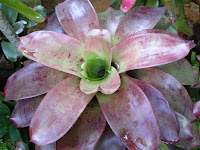


Lyndi organised a visit to Pearl's garden yesterday morning. As you can see, Pearl is mostly into bromeliads, having grown them for many years now. Her collections consists mainly Neoreglias in various hues and sizes. She does have the odd Aechmea, Alcantera and Billbergia lurking somewhere.
Her patch is pristine and orderly, quite the opposite of what I would do, given my love for lush foliage. Still such garden visits are often exciting and a joy to attend as it gives fellow enthusiasts insights into what others grow or create, thus giving them the inspiration to do or change something about their own gardens. Yes, it is to a certain extent, copying, but I see no harm in that. Where the garden is concerned, there is no such thing ownership over landscape creativity. If anything, it is possibly the greatest compliment to get when one learns and gets ideas from your garden.
Then again, all this may be moot for i've yet to see similar gardens around. At the end of the day, everyone gets general ideas about what they want to do, but the end result is always almost different. It boils down to various things like choice of plants, land-size, environment, terrain, arrangement, colour scheme, the use of elements etc. For some, it may even be an opportunity to improve on what they see. For example, I like the layout of the Ginger Gardens at the Singapore Botanic Gardens, but if I had it my way, I would do some things differently. In essence, I get the idea and improve upon it, thus making it my own.


 My broms collection is rather eclectic. I suppose it's largely because I don't go just for colour but am also interested in the form. This explains why my brom collection tends to consists of rather interesting and lesser known broms such as Hohenbergia, Dyckia, Androlepsis and Alcantarea. I also tend to go for the rarer Neoregelias, Billbergias, Vriseas and Aechmeas such as the exotic Aechmea orlandianas, the rather rare Neo. Jaline, the very large Billbergia stenopetala and the Vrisea Simplex which has flowers resembling that of the Heliconia rostrata. Once I get a place of my own, I will incorporate these into the garden; some on branches of trees together with other epiphytes like orchids, spanish moss and ferns, while the others at ground level amidst foliage.


 Remember the scene in the Revenge of the Sith (Star Wars) where the Jedi Aayla Secura was betrayed and killed by her own clone troopers on the planet Felucia? The planet had all these strange and exotic plants and I swear, the Puya would have just fit right in.
 Several weeks back, I posted some photos of my potted pineapple plant (Ananas comosus) which flowered. Aout 2 months later, I managed to harvest the fruit of my labour and i'm proud to say that, THAT was one sweet pineapple.


